



Dengue fever: Symptoms, treatment and ways to prevent mosquito infection
Dengue is a mosquito-borne viral infection that can cause high fever and severe pain. Health authorities stress early care, hydration and mosquito protection.


By Ahmet Taş | Wise News Press
ANKARA, TURKEY — Dengue fever, a mosquito-borne viral infection that affects millions of people each year, has returned to public attention after Turkish journalist Serdar Akinan said he had contracted the disease and required hospital care.
Akinan said he sought medical attention after developing severe weakness and high fever and was told that he had dengue transmitted by an Aedes mosquito. He later reported that his general condition had improved, although some blood-test indicators had not yet returned to normal.
The World Health Organization describes dengue, sometimes called “break-bone fever,” as a viral infection transmitted from mosquitoes to humans. Most infections cause no symptoms or only mild illness, but some cases can progress to severe dengue and require hospital treatment.
What is dengue fever?
Dengue is caused by the dengue virus and is transmitted primarily through the bite of infected Aedes mosquitoes, particularly species that commonly live in and around human settlements.


The disease is most common in tropical and subtropical climates. WHO estimates that hundreds of millions of dengue infections occur worldwide each year, with billions of people living in areas where they may be exposed to the virus.
The infection is widespread in parts of Southeast Asia, Central and South America, the Caribbean and the Pacific, while changing environmental conditions and international travel have increased concern about dengue appearing in areas where it was previously less common.
Most people infected with dengue either have no symptoms or recover within one to two weeks. When symptoms develop, they usually begin several days after infection.


What are the main symptoms of dengue?
According to WHO, common symptoms include high fever, severe headache, body or joint pain, nausea, vomiting and skin rash. Pain behind the eyes and swollen glands may also occur.
The disease became known as “break-bone fever” because some patients experience severe muscle, joint and body pain.
Most symptomatic cases improve without serious complications, but a small proportion can develop severe dengue. Severe cases can deteriorate rapidly and may require urgent hospital care.
Warning signs are particularly important around the period when the fever begins to subside. Euronews, citing health guidance, lists severe abdominal pain, persistent vomiting, bleeding from the nose or gums and blood in the stool among symptoms requiring urgent medical evaluation.
People who develop signs of bleeding, severe weakness, persistent vomiting or other rapidly worsening symptoms should seek medical care rather than attempting to manage the illness solely at home.
How does dengue spread?
Dengue is primarily spread when an Aedes mosquito bites a person infected with the virus and later transmits the virus while feeding on another person.
Aedes mosquitoes often breed close to homes. Containers that collect stagnant water — including buckets, flowerpot trays, water-storage containers and pet water bowls — can provide breeding sites.
Human-to-human transmission without mosquitoes is uncommon. Euronews, citing health authorities, notes that transmission can occasionally occur from a pregnant woman to her baby and, more rarely, through blood exposure, organ transplantation or needle-related incidents.
Because the mosquito vector thrives around densely populated areas, dengue outbreaks can spread quickly when weather and environmental conditions favor mosquito reproduction.
Is there a specific treatment for dengue?
There is currently no specific antiviral treatment for dengue. Treatment focuses on managing symptoms, maintaining adequate hydration and closely monitoring patients for signs that the disease is becoming severe.
For patients being managed outside hospital, the US Centers for Disease Control and Prevention recommends rest, adequate oral fluids and acetaminophen — also known as paracetamol — for fever and pain when appropriate.
Health authorities specifically advise people with suspected dengue to avoid aspirin and non-steroidal anti-inflammatory drugs such as ibuprofen, because they can increase the risk of bleeding.
This is particularly important because severe dengue can involve bleeding and circulatory complications.
Early recognition and proper clinical care substantially improve outcomes. WHO guidance has long emphasized that access to appropriate medical treatment can reduce the fatality rate of severe dengue to below 1 percent.
Medication choices should therefore be discussed with a healthcare professional when dengue is suspected rather than relying on routine treatments for ordinary fever.
How can people protect themselves from dengue?
The most effective prevention strategy is to reduce mosquito bites and eliminate places where Aedes mosquitoes can reproduce.
WHO recommends measures aimed at avoiding mosquito bites, including protective clothing and appropriate repellents. Because mosquitoes that transmit dengue frequently live around homes and gardens, environmental control is also important.
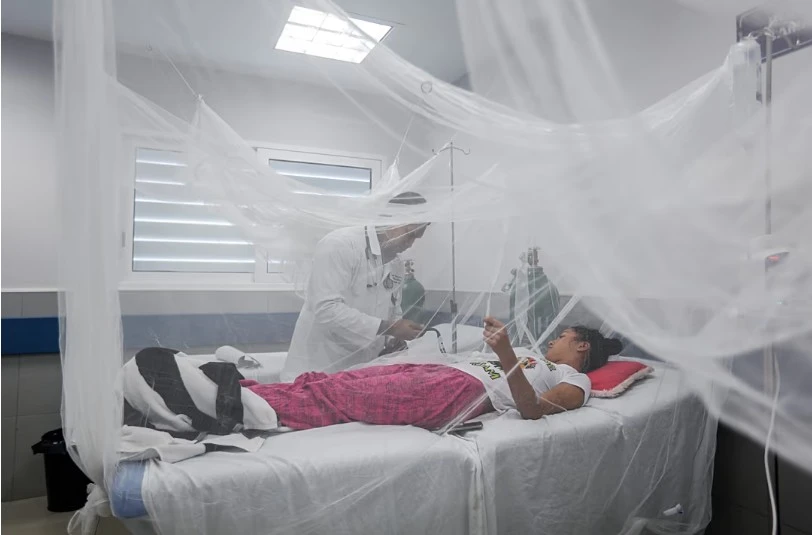
Containers that can hold standing water should be emptied, cleaned or securely covered. Flowerpot trays, buckets, water tanks and similar objects around homes should be checked regularly. Euronews also cites the use of window screens and mosquito nets among practical protective measures.
These precautions are especially important for people living in or traveling to areas experiencing active dengue transmission.
Preventing bites also matters after a person becomes infected because a mosquito that bites an infected individual can potentially acquire the virus and contribute to further transmission.
Is there a dengue vaccine?
Vaccination is available, but it is not a universal replacement for mosquito-control measures.
WHO currently recommends the TAK-003 vaccine, also known as Qdenga, for children aged 6–16 years in settings where dengue transmission is intense and the disease represents a major public-health burden. The recommended schedule consists of two doses administered three months apart.
WHO does not recommend its routine programmatic use in every country or every transmission setting, meaning vaccination policies can differ depending on local dengue risk, age and national health guidance.
For travelers or people living in areas where dengue occurs, mosquito-bite prevention therefore remains a central protective measure.
Akinan’s reported illness has once again highlighted how a bite from a small mosquito can result in a potentially serious infection. As dengue expands as a global public-health concern, health authorities continue to emphasize awareness of symptoms, early medical evaluation when warning signs appear and consistent measures to reduce exposure to Aedes mosquitoes.
WiseNewsPress.com
Tepkin Ne?
 Harika
0
Harika
0
 Kötü
0
Kötü
0
 Sevdim
0
Sevdim
0
 Komik
0
Komik
0
 Şaşırdım
0
Şaşırdım
0
 Üzücü
0
Üzücü
0
 Kızdım
0
Kızdım
0

Ahmet Taş, gazeteci ve yazardır. YerelGundem.com'da siyaset, yerel yönetimler, toplumsal gelişmeler ve Türkiye gündemine ilişkin haber, yorum ve içerikler kaleme almaktadır.






















Yorumlar (0)